City of Outsiders: Why Łódź Has Always Been a Place for the Different and the Bold
There are cities whose identities are forged through monuments, wealth, or geography. And then there are cities like Łódź—a place defined not by what it has, but by whom it has welcomed, and why. Often overshadowed by Warsaw’s politics or Kraków’s cultural prestige, Łódź holds a more subterranean narrative: one of flux, defiance, and a strange, stubborn magnetism for outsiders. This is the story of a city born from the margins, and shaped by the different and the bold.
The City as a Canvas of Contradictions
Located in the heart of Poland, Łódź (pronounced “woodge”) is both nowhere and everywhere. It lacks the Renaissance grandeur of Kraków or the imperial formality of Warsaw. What it does have is a kind of raw openness, a gravitational pull for those who don’t fit elsewhere. From its 19th-century industrial boom to its post-Communist struggles and resurgence, Łódź has consistently offered refuge—not always with warmth, but always with space—for those willing to reshape themselves or their world.
The philosopher Michel Foucault once described heterotopias—real places that function outside of conventional norms, where society’s rules are suspended. Łódź, in many ways, is Poland’s heterotopia. A place where utopias failed and yet something vital, even prophetic, persisted.
A Patchwork of Identities
In the 19th century, Łódź exploded from a sleepy village into a textile empire almost overnight. But unlike cities where industrialization followed a single ethnic or class line, Łódź’s development was a confluence of many streams. Germans brought capital and know-how. Jews contributed to trade, culture, and entrepreneurship. Poles brought labor, resistance, and nationalism. Russians imposed power. These groups did not always live in harmony, but they coexisted in an entangled dance of necessity and invention.
The result was a peculiar kind of urban personality—not cosmopolitan in the polished Parisian sense, but multicultural in a more volatile, lived-in way. You could walk a single street in Łódź and hear four languages, pass a Catholic church, a synagogue, a Lutheran church, and an Orthodox one, all within minutes. This polyphony created a city in constant negotiation with itself.
Outsider Artistry and Industrial Ruin
Even its art is different. The Łódź Film School—alma mater to Andrzej Wajda, Roman Polański, and Krzysztof Kieślowski—produced visionaries not by imitating Hollywood, but by insisting on moral ambiguity, poetic imagery, and psychological realism. In a city where beauty was rare, artists learned to find the sublime in the ruined.
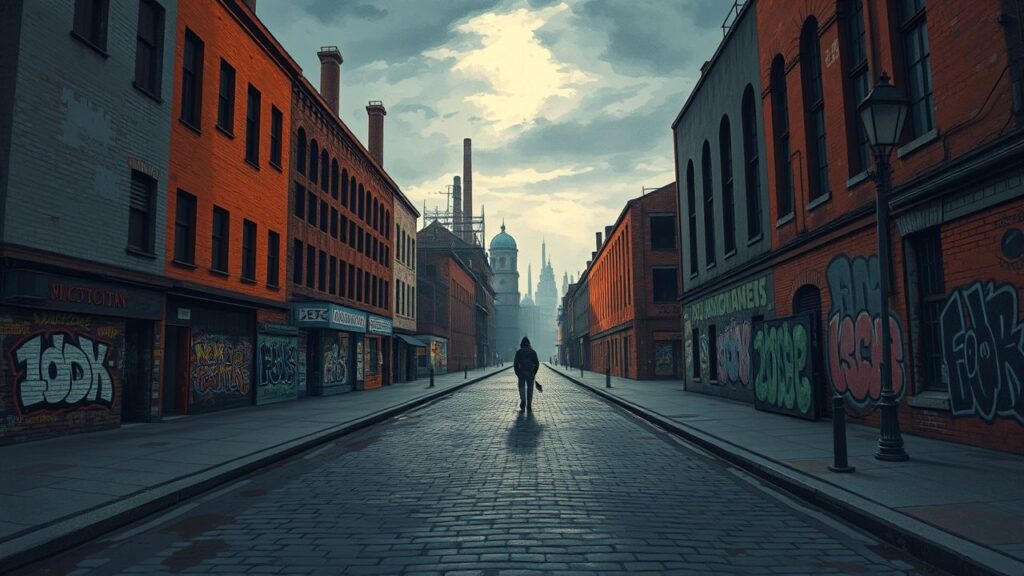
As factories shut down in the late 20th century, Łódź was often cited as a symbol of post-industrial decay. But this decay itself became fertile ground for reinvention. The ruins of capitalist ambition became art spaces, start-up hubs, or simply romanticized relics. Here, ruin wasn’t the end, but a texture—a way of reading time.
The Philosophical Outsider
There’s something existentially compelling about Łódź. It doesn’t seduce with surface appeal; it demands introspection. In this way, it mirrors the existential condition of the outsider—a figure both alienated and radically free. Jean-Paul Sartre argued that the outsider, in their estrangement, sees the world most clearly. Łódź, a city of migrants, exiles, and survivors, has long embodied that clarity.
And it has paid the price. The Holocaust nearly erased its vibrant Jewish life. The Communist period flattened its pluralism into a grey uniformity. Yet even through these traumas, Łódź remained a city for those who didn’t belong elsewhere—or perhaps didn’t want to.
A New Kind of Courage
Today, Łódź is experiencing a quiet resurgence. It’s not flashy. It doesn’t trade in spectacle. But walk down Piotrkowska Street and you’ll see the signs: former textile mills reborn as cultural centers, graffiti that reads like philosophy, a creative economy that values substance over sheen.
Its new residents—artists, entrepreneurs, digital nomads—are not just rebuilding the city but channeling its old energy: the stubborn audacity to be different.
Conclusion: The Lodzian Spirit
To be from Łódź—or to come to Łódź—is to accept contradiction. To live among ruins and reinventions. To be part of a story that is neither linear nor triumphant, but richly human. Łódź doesn’t offer comfort. It offers challenge. And in doing so, it attracts the only kind of people who can truly thrive there: the different, the daring, the bold.
In a world increasingly obsessed with polish and perfection, Łódź remains gloriously unvarnished. It’s not a city for everyone. But perhaps that’s the point.